

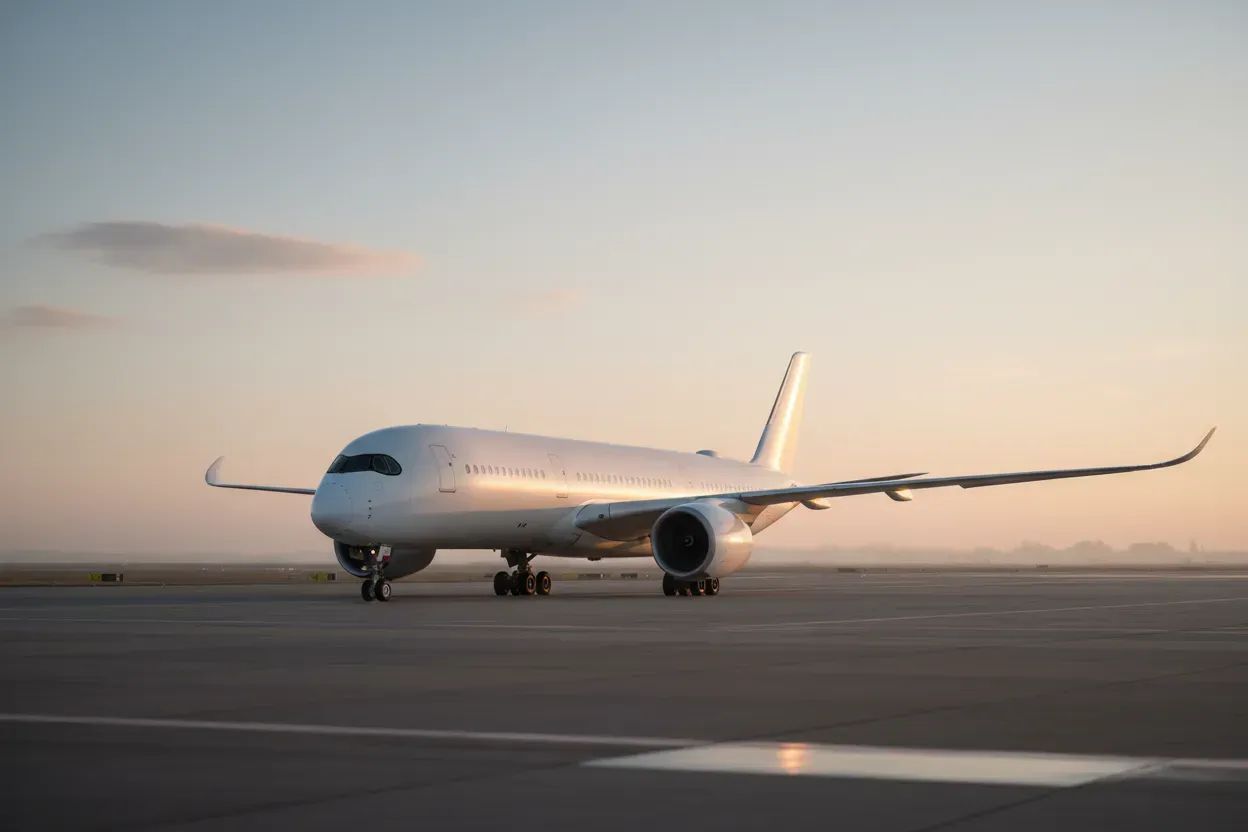




Pursue Healthier Pressurization Plus Hospital-Grade Filtration
Ysabel FlorendoMarketing coordinator · Davila's ClinicFrom a healthcare perspective at Davila's Clinic, air travel comes up more than you might think. Several of our patients in the Rio Grande Valley are snowbirds who travel to visit family, and we also have staff who attend medical conferences across the country. The aircraft I'd most want to experience is the Airbus A350 because of what it represents in terms of cabin air quality and pressure. Most people don't realize that cabin air pressure on commercial flights is equivalent to being at 6,000 to 8,000 feet of altitude, which is why passengers often feel fatigued, dehydrated, and sometimes dizzy during long flights. The A350 maintains a lower effective cabin altitude, around 6,000 feet compared to 8,000 on most older aircraft; which means the air is denser and closer to what your body is used to at ground level. For our patients with respiratory conditions, cardiovascular issues, or even just elderly travelers who feel the effects of altitude more acutely, this difference isn't trivial. I've had patients cancel trips because they were worried about how their body would handle a long flight, and better cabin pressurization could make the difference between a manageable trip and a medical event. The A350 also uses a hospital-grade HEPA filter system that refreshes cabin air every two to three minutes, which is reassuring from an infection control standpoint. What intrigues me most isn't the luxury features or the seat desig; , it's the underlying engineering that makes the flying experience healthier for passengers who don't have a choice about needing to travel.
Crave Quiet Space on the Superjumbo Upper Deck
Belle FlorendoMarketing coordinator · Mano SantaThe aircraft I'd most want to fly on is the Airbus A380. Not for any technical specification or engineering milestone, but because I'm curious about the experience of being on something that large and that quiet at the same time. I've done enough cross-country flights for work that I've become oddly interested in the cabin experience itself rather than just getting from point A to point B.
At Mano Santa Note Servicing, I travel several times a year to meet with note holders and attend industry conferences. Most of those flights are on standard narrow-body aircraft, and the difference between a decent seat and a miserable one on a three-hour flight is something I've spent too much time thinking about. The A380 interests me because everything I've read about the cabin experience suggests it's fundamentally different from any other commercial aircraft. The sheer size means less engine noise, more cabin air volume per passenger, and a sense of space that you just don't get on a 737 or A320.
What intrigues me most is the upper deck. The idea of being in a smaller, more intimate cabin at 35,000 feet while knowing there's an entire other deck below you is appealing in a way I can't fully explain. It's the aircraft equivalent of a private office within a larger building. Several colleagues who've flown on A380s describe it as the least stressful long-haul experience they've had, and for someone who spends work flights reviewing borrower files and preparing for meetings, anything that reduces travel fatigue is valuable.
I know the A380 is being phased out of many fleets, which is part of why I want to experience it while I can. There's something appealing about riding on what might be the last of the true superjumbos, an era of commercial aviation that won't be repeated as airlines shift to smaller, more fuel-efficient twin-engine aircraft. I'd want a window seat on the upper deck, ideally on a daytime flight so I could actually see the scale of the aircraft from the outside during boarding.
Celebrate Audacious Speed That Democratizes Distance
Runbo LiCEO · Magic Hour AII'm Runbo Li, Co-founder & CEO at Magic Hour.
The Concorde. I know it's been retired for over two decades, but that's exactly what makes it the answer. The Concorde wasn't just an aircraft. It was a bet that speed could collapse distance, that technology could literally compress time. New York to London in three and a half hours. That idea still feels radical.
What intrigues me most isn't the luxury or the prestige. It's the philosophy behind it. Someone looked at the Atlantic Ocean and said, "We can cut this in half." That's the same energy I think about every day building Magic Hour. We looked at video production that took a full day and said, "This should take 30 seconds." The Concorde proved that when you remove friction from movement, entirely new behaviors emerge. Business deals that couldn't happen started happening. People lived between continents in ways that weren't possible before.
I think about this a lot because I grew up watching my parents run small businesses, spending hours on things that should have been instant. My mom would spend an entire evening trying to make a single promotional video for her store. The tools were slow, expensive, and built for professionals. That friction wasn't just annoying, it was a barrier to economic opportunity.
The Concorde failed commercially because the economics didn't scale. Tickets cost $12,000 a seat. Only a tiny slice of people could access it. And that's the part of the story I find most instructive. Speed without accessibility is just a luxury. Speed with accessibility is a revolution. That's the difference between the Concorde and what's happening with AI right now. AI video tools aren't reserved for the elite. A teenager in Lagos and a marketing director in Manhattan have access to the same creative power.
If they ever bring back supersonic commercial flight at a price normal people can afford, I'll be first in line. But the thing I loved most about the Concorde was never really about the plane. It was about the audacity of compressing what everyone assumed was fixed.
Witness Precision in Medical Air Freight
Rina GutierrezMarketing Coordinator · MacPherson's Medical SuppyI don't have a strong aviation background, but from a medical supply logistics perspective, I'd love to experience a flight on one of the cargo-configured 747s that companies like Atlas Air operate. We ship durable medical equipment across Texas and occasionally out of state, and the logistics chain that gets hospital supplies from manufacturer to distributor to patient is something I think about more than most people probably do. A lot of the critical medical supplies and equipment we rely on, especially things like specialized wound care products and bariatric equipment that aren't stocked locally, come through air freight networks. Being on one of those flights and seeing how the cargo is managed, the temperature controls for sensitive items, the whole chain of custody process, would be genuinely interesting to me. I've read that some of these freighter operations are remarkably precise, with specific loading sequences to maintain weight and balance and dedicated compartments for medical and pharmaceutical shipments. In our business, we obsess over the last mile of delivery, getting the right equipment to the right patient's home at the right time. Seeing the first mile from the air would give me a much better understanding of the full supply chain we're a part of. It's not the most romantic aircraft dream, I admit. Most people probably want to fly the A380 or a private jet. But I think understanding how things actually move through the world, including the invisible logistics infrastructure that keeps healthcare running, is genuinely fascinating once you start paying attention to it.